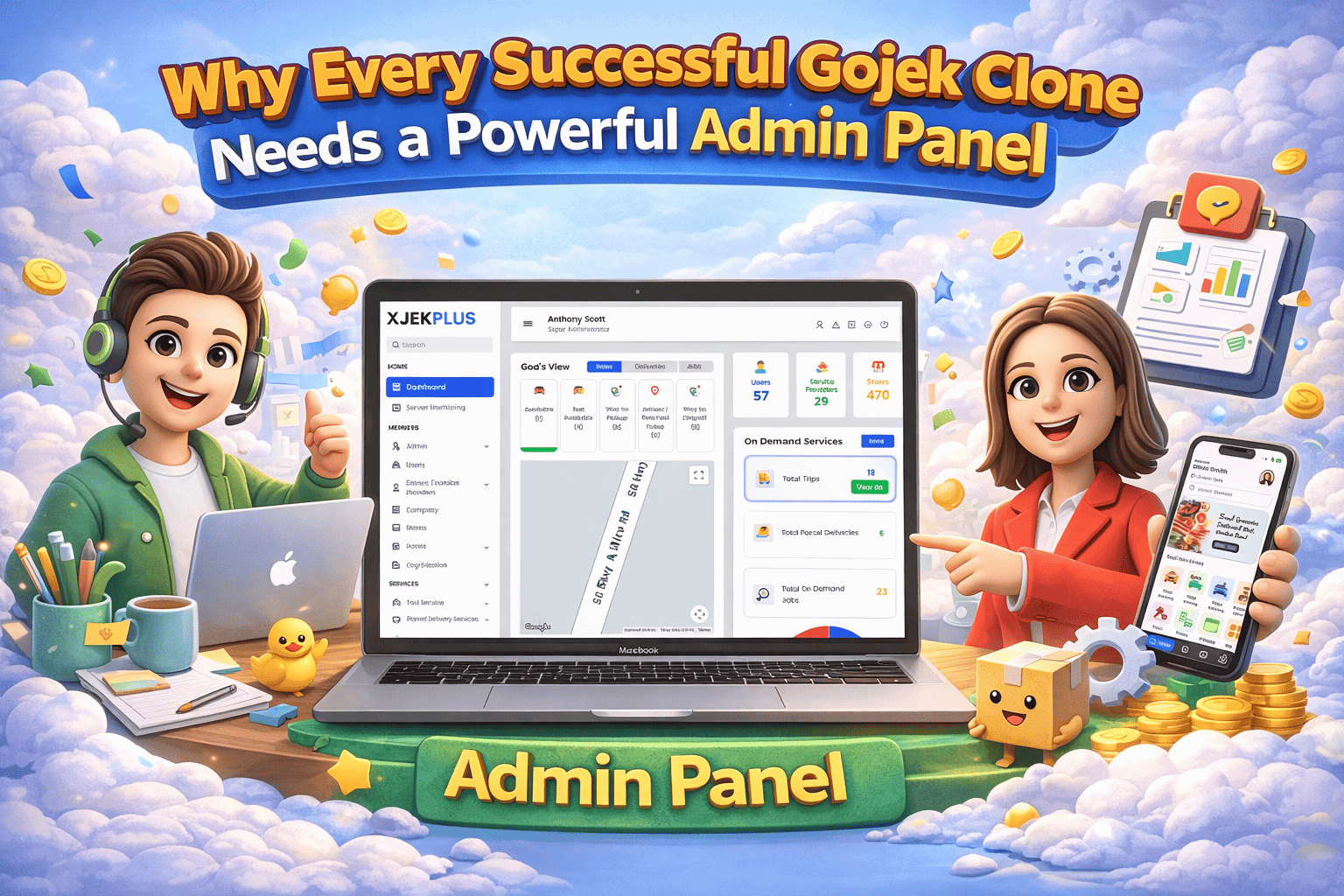
Launching a Gojek Clone app is like crossing the end of the road. You’ve created a sleek user interface as well as your driver-matching algorithm and the payment gateway integration, and everything else you need to shake up your local market. Your investors are thrilled. The marketing department is set to go live. However, here’s the unpleasant fact: your application that is aimed at customers is only half of the process.
The most important factor in successful apps isn’t exactly where your users can view it. They’re hidden away behind your scenes on a dashboard that the majority of entrepreneurs overlook until things begin getting disastrously wrong.
The Hidden Crisis Most Gojek Clone Owners Face
Let’s create a realistic scenario. It’s 3 am, and your support staff is inundated with complaints. Drivers aren’t showing up on the app. Customers aren’t able reserve rides. Settlements for payments are in an indefinite state. Your CTO is desperately trying to determine what’s going on while you refresh your server’s the logs each 30 seconds.
This problem usually traces its roots to a single root that is a malfunctioning or insufficient administration panel.
If you decide to go with an entry-level Gojek replica, whether bought off the shelf or from a rush group of developers, you will typically receive a basic administration interface. It could provide basic user management as well as some basic reports. But the real world demands far more. If you don’t have the proper tools for managing, it’s like in a blind spot.
Take a look at this: A ride-sharing operation is characterized by hundreds of micro-transactions every day and a variety of user types (customers, drivers, customers and merchants) and dynamic price adjustments, promotions, fraud detection, as well as regulatory compliance. The management of all this via an unorganized admin experience is not just inefficient but also risky.
What Makes an Admin Panel Actually Powerful?
Here’s what distinguishes amateur Gojek clone companies from the market top players:
Live Operational Availability
The administrative team must have access to live dashboards that display the status of active travel, pending orders, drivers’ locations, and the status of your payment processing. It is not refreshed every 10 minutes. This is not yesterday’s data. Today.
Dynamic Price Control
Capacity to alter commission rates, price surge algorithms, and other fees for different times, zones, and driver types without redeploying the entire application. Price changes by competitors happen in minutes. It shouldn’t take two days of development time and a team.
Complete User Management
Handling hundreds of driver accounts isn’t only about enabling accounts. It’s about establishing individual ratings limits, coordinating document verification statuses, dealing with complaints, removing criminals immediately, and ensuring audit records. An insecure admin panel can turn this into an issue.
Advanced Promotion Engine
Managing campaigns such as first-ride discounts as well as loyalty rewards, and surge incentives should use drag-and-drop and not dependent on code. Your marketing team should not require the approval of a developer for each campaign.
Fraud Detection and Dispute Resolution
Fake accounts and double bookings, as well as payment frauds; they happen. Your admin team requires tools to look into, identify patterns, and resolve disputes without sending them to developers each time.
Multi-Currency and Multi-Region Support
When you’re expanding past the initial market, you’ll require administrative controls for various currencies, as well as tax regulations and the requirements of regional compliance.
Advanced Analytics and Insights
Raw reports are ineffective. You must understand the impact of patterns of behavior in cohorts, driver retention, as well as the value of customer lifetime, the economics of units by location, and predictive churn indicators.
Integration Management: The application will connect to payment gateways as well as GPS providers, SMS providers, KYC platforms, and insurance partners. These integrations are broken. They require monitor, switch, as well as debugging from your administration panel.
The Compounding Problem of Poor Admin Architecture.
This is what makes ineffective administration panels especially dangerous:
Your app may work flawlessly initially with 100 users. However, as you scale the number of users, the cracks begin to appear, followed by cracks, and finally. Every operational problem which your administration team is unable to overcome using the UI becomes support ticket, a development ticket, or a complaint. As your team expands, your operational complexity rises, and you’re now paying engineers to handle the things that a good administrator tool is supposed to do efficiently.
The Gojek clones hit a critical moment of inflexion. Some teams take the plunge and build their administration infrastructure from scratch, a 3-6 month project that costs several hundred thousand dollars. Others stutter along with a few solutions that increase the cost of operations and risk assessment.
There’s a third option, but.
The Gojek Clone Architecture That Actually Works
Super app developers who are successful have one common element that they’ve constructed scalable, complete administration infrastructure since day one.
The most efficient approach employs an API-first and modular design, which makes your admin paneln’t an add-on feature, but it’s a co-equal platform to your app for customers. This structure permits:
Granular permission control: Team members only see what they require.
Audit trails: Each action can be traced and logged to ensure conformity.
Automated workflow: Chains of approval rules for escalation along with automated replies.
Customized reporting: Data flows into the dashboards you have designed for your business requirements.
Integrations from third parties: The administrator panel communicates with the accounting system, CRM software as well as BI systems.
Mobile access: Your team of operations can work from any location.
The teams that do this right usually use white-label or customized solutions designed specially for Super Apps, platforms that were designed with the beginning in mind to handle food delivery, ride-sharing market transactions, and logistics all at once.
Why? Because these solutions have been tested over hundreds of markets, as well as thousands of transactions. They’ve resolved issues you’ve never experienced before. They’ve created the infrastructure to ensure compliance for the regions you’re planning expanding into, They’ve thought of possible edge cases that would require you and your staff months identify.
The Real Cost of Getting This Wrong
Let’s talk about the financial consequences. A badly functioning admin panel will cost you:
Inefficiency at work, your team is 20% slower than they should because they’re working manually what software is supposed to automate.
Customer churn: Each support issue erodes confidence.
Driver satisfaction: Drivers leave platforms that seem unsafe or unfair.
Compliance risk: Insufficient tools to ensure compliance could lead to legal complications.
It is impossible to increase beyond the capabilities of your admin team to handle operations.
The cost savings in the early stages of the Gojek clone? It’s a down payment on higher-end costs later.
Where to Go From Here
If you’re creating a Gojek clone yourself, these queries:
1. Does your admin team have the capacity to manage 10 times the load of users currently using your current administration panel? If not, you’ve already hit your ceiling.
2. How many crucial operational tasks still require the involvement of developers? Each one of them can be an obstacle.
3. Have you got real-time access into all important business metrics? If you’re waiting on reports, you’re ahead of your competitors.
4. Do you have the ability to launch a brand new campaign or modify business rules without having a development sprint? If you’re not, then you’re not competing.
5. Are you and your team members seeking administrative tools that aren’t available? This is a message you should not ignore.
The most effective super app operations don’t simply launch apps; they also create operating platforms. Your Gojek replica isn’t a destination, it’s a place to start. The infrastructure you create behind the scenes will determine whether you succeed or be a part of the world’s most competitive industry. The app you provide to customers gets customers on their way to your door. Your admin panel keeps you running.