Introduction: Delivery Apps in 2026
The industry of on-demand delivery isn’t slowing down. Not even close.
By 2026, the world market for grocery and food delivery is predicted to exceed $500 billion. Customers in the US have come to expect delivery for food, drinks grocery items, as well as pet products in 30-45 minutes. The expectation of delivery isn’t going out of the window. It’s just getting louder.
In the midst of all this potential is the Postmates clone which is among the most popular and downloaded delivery apps in the world. Postmates was founded on its promise to deliver any item, anywhere, in a hurry. Businessmen saw that promise and wished to have a piece of it. This is not surprising.
Here’s a topic that people don’t talk about enough. Many people who want to create a Postmates clone commit the same mistakes. These errors cost their time, money and, in some cases the entire company. If you’re planning for the launch of a delivery application in 2026, reading this article before you invest a dime could be the best choice you take this year.
About Postmates Clone
Before we dive into the pitfalls we should make sure we’re all in the same boat about what an actual Postmates clone is in reality.
A Postmates clone is a delivery application that replicates the basic functionality of Postmates. It includes delivery across multiple categories and real-time driver tracking orders management, applications for the customer as well as a backend administration panel. The clone model was created because creating something similar to Postmates from scratch is extremely expensive and laborious.
A quality Postmates clone gives you a tested, working product that can be branded with your personal brand, customise to your specific city or market and launch within weeks, not years.
When used properly, it’s one of the best way to get into the current delivery economy. If used incorrectly and that’s what the majority of people who are new to the business do, it turns into an economic sinkhole.
These are the three mistakes you must not make.
Three Crucial Mistakes People Make While Developing a Postmates Clone
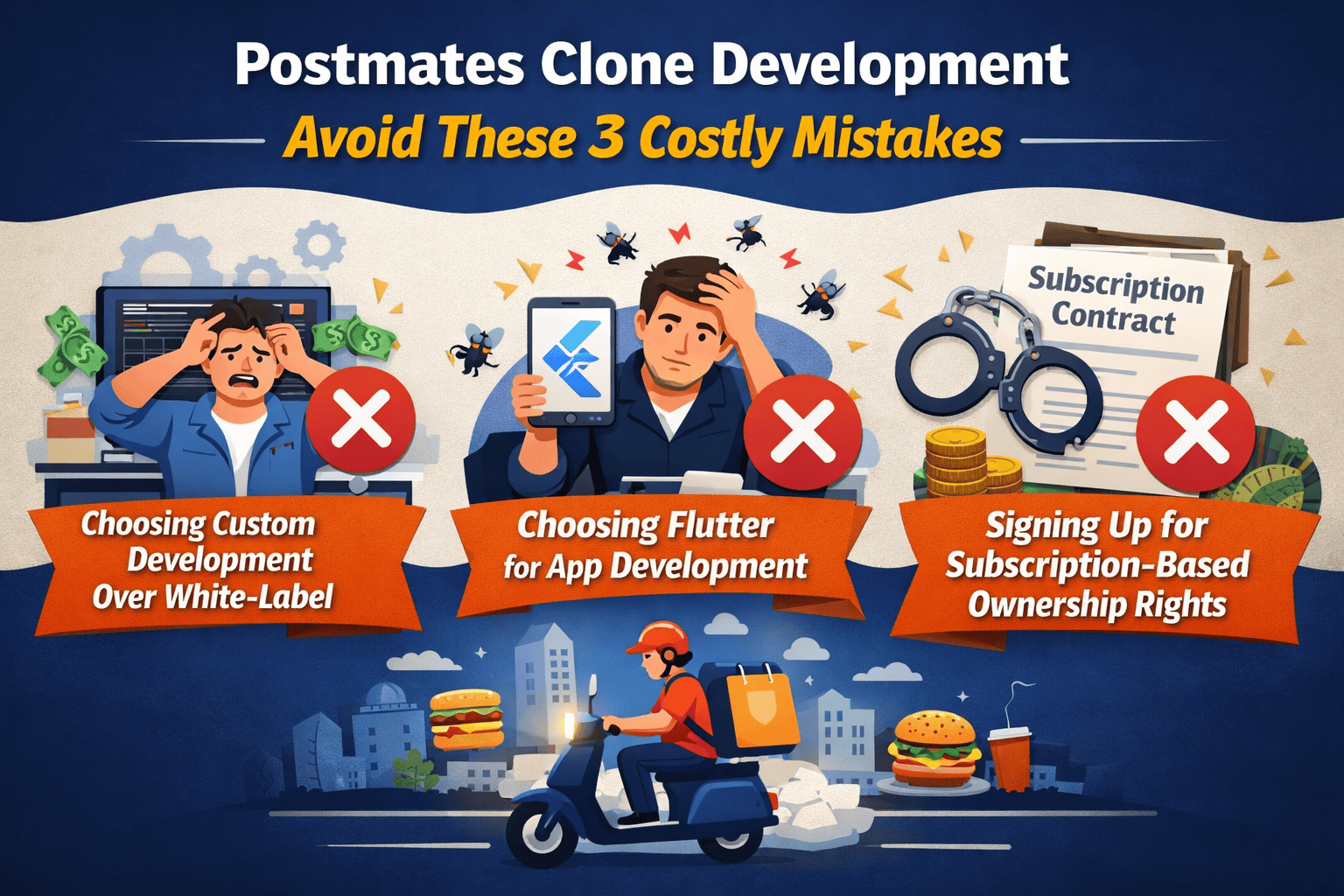
Choosing Custom Development Over White-Label
This is the most common error. And it’s the most costly.
When business owners first come up with the idea to create delivery apps the first instinct is to create a custom. They want complete control. They want something different. They imagine a team of tech experts developing their idea from scratch. It sounds thrilling.
What actually happens isn’t anything exciting.
A fully-featured delivery software can range from $100,000 to $400,000. This doesn’t even include QA testing and fix for bugs servers, server infrastructure, and the inevitable scope increase that adds months the time frame. The majority of custom builds take between about 12-24 months from concept to live product. When they are finally launched they’re already way far behind the competition.
White-label Postmates clone is on contrary, provides the user a ready-to-use product at less than the price. The basic technology is already in place. You’re not paying experts to develop code that’s been written 100 times before. You’re paying to modify or brand an existing product.
If any business owner is planning to enter the delivery industry in 2026 Customization is not an indicator of determination. It’s an indication of lack of experience. The market fluctuates too quickly for build cycles of 18 months.
Choosing Flutter for App Development
The second one may be more complex, but equally harmful. A majority of clone companies and development agencies recommend Flutter as their application development framework as it is less expensive to build using. One codebase, two platforms. Sounds efficient, right?
The issue is that Flutter apps are a bit sloppy and have real limitations when it comes to delivery. This is the most important thing to your customers:
Real-time GPS tracking in delivery apps demands native-level performance. Flutter’s bridge design introduces latency that users are aware of, particularly in busy delivery times. When a driver updates their position every 3 seconds, and a client is watching the dot change across a map, that slowness can undermine confidence.
Background location service, crucial for driver applications, work much worse when using Flutter than the native iOS or Android development. Drivers experience higher battery drain inconsistency of pings and gaps in location. These are not just minor UX issues. They can directly affect the accuracy of your delivery as well as your retention rates of your drivers.
Payment gateway integrations, advanced linking and push notification reliability are all more complex and less secure in Flutter. If you are a delivery application where the need for order notifications is mission-critical the above isn’t an option worth taking.
The better option is to choose a clone that is built using native React Native architecture, where the performance and GPS security, as well as particular behavior for the platform are not negotiable. When looking at Postmates clone vendors, always check out the tech stack prior to signing any agreement.
Signing Up for Subscription-Based Ownership Rights
It is the kind of trap which doesn’t appear to be it until you’re already caught.
Certain clone vendors offer access to their platforms via the basis of a subscription. The cost is a monthly amount that is usually between $300-$1,500 In return, you can use their software. Your brand name is visible on the software. Your customers use it. However, the code isn’t yours.
On the surface, it appears cheap. A monthly fee of $500 seems much better than an upfront investment of $150,000. However, if you run the numbers over a period of three years, and you’ve paid $18,000 but have no evidence to back it up. No source code. No ownership. The vendor is not able to modify the product beyond what is allowed by the vendor.
In addition, you are dependent on the vendor’s business choices. If they increase their prices then you will pay more or you’re unable to access your application. If they close the business, it shuts down along with the company. If they make a change to the feature you rely on, there is no recourse. You’re renting a company which should be owned by you.
The only model of ownership that is worth embracing when you launch a Postmates clone is complete source code ownership. This is only one payment. You only pay one time. You own the item. You can modify it as you wish. You can scale it up without permission. It is only a system that offers you a genuine business, not an authorized service that you will never completely control.
Launching a White-Label Postmates Clone: The Ultimate Solution
Once you’ve figured out what to avoid here’s what actually is working.
White-label Postmates clone with full source code ownership, based using a robust Native or React Native framework, is the best way to start an application for delivery in 2026 without burning a hole in your budget or putting off your timetable.
Here’s how the ideal solution should look like in the real world:
The license is a one-time purchase to fully-integrated delivery platform. It includes a customer application, driver’s program, an app for merchants’ application and an admin dashboard. This code source is transferred to you. You collaborate with the team of the vendor or your own developer to redesign the app, set up the delivery areas, establish the commission rates and connect the payment gateway.
In a matter of one to two weeks, you will be living.
You can start in one city and test your design and refine your driver’s onboarding process, and then expand. Because you control the code, any modification you create is an asset for your company. You build equity with each new version.
These are the ways smart operators are preparing to enter into the market of delivery in 2026. They’re not spending two years constructing their software from scratch. They’re not leasing software from someone else for the rest of their lives. They’re purchasing a tried and tested product that they have made their own, and advancing swiftly enough to take market share prior to the time when the window is closed.
For those in the United States who see delivery as a potential business opportunity, the white-label option is not the best option. It’s the industry standard.
Conclusion: Build Your Postmates Clone the Right Way
The delivery economy of 2026 is full of opportunities. However, it’s filled with costly errors which engulf businesses before they ever start to grow.
Do not create custom applications if an established clone exists. Avoid Flutter-based applications when performance and reliability are crucial. Never ever subscribe to a model of subscription unless the option of full ownership is offered.
An white label Postmates clone founded on proven technology, with full control of the source code lets you launch swiftly start smart, launch with precision, and develop a delivery application business which you manage.
Frequently Asked Questions
What exactly is the definition of a Postmates clone and how do they function?
A Postmates clone is a delivery application that has been pre-built which replicates the functionality of Postmates. It comes with applications for drivers, customers and merchants, as well with an administration panel. You purchase it, then label it as your own, and then you launch it in the market you choose.
What is the reason why Flutter is not recommended as delivery apps?
Flutter introduces performance problems with live-time GPS monitoring and location tracking services for background which are essential for delivery applications. Native and React Native development can provide greater reliability, particularly for accuracy of location information on the driver’s side.
What is full Source Code Ownership mean to my company?
Full source code ownership means that you have the files that compose the app. You can alter and resell or extend the app with no limitations from a vendor. There are no monthly charges and no dependence on an external platform to remain operating.
How much time it’ll take to go live with a Postmates clone in 2026?
With a white-label solution, most companies launch within four to six weeks. It includes branding customizing as well as payment integration and submission to the app store. Customization, however usually takes between 12 and 24 months.