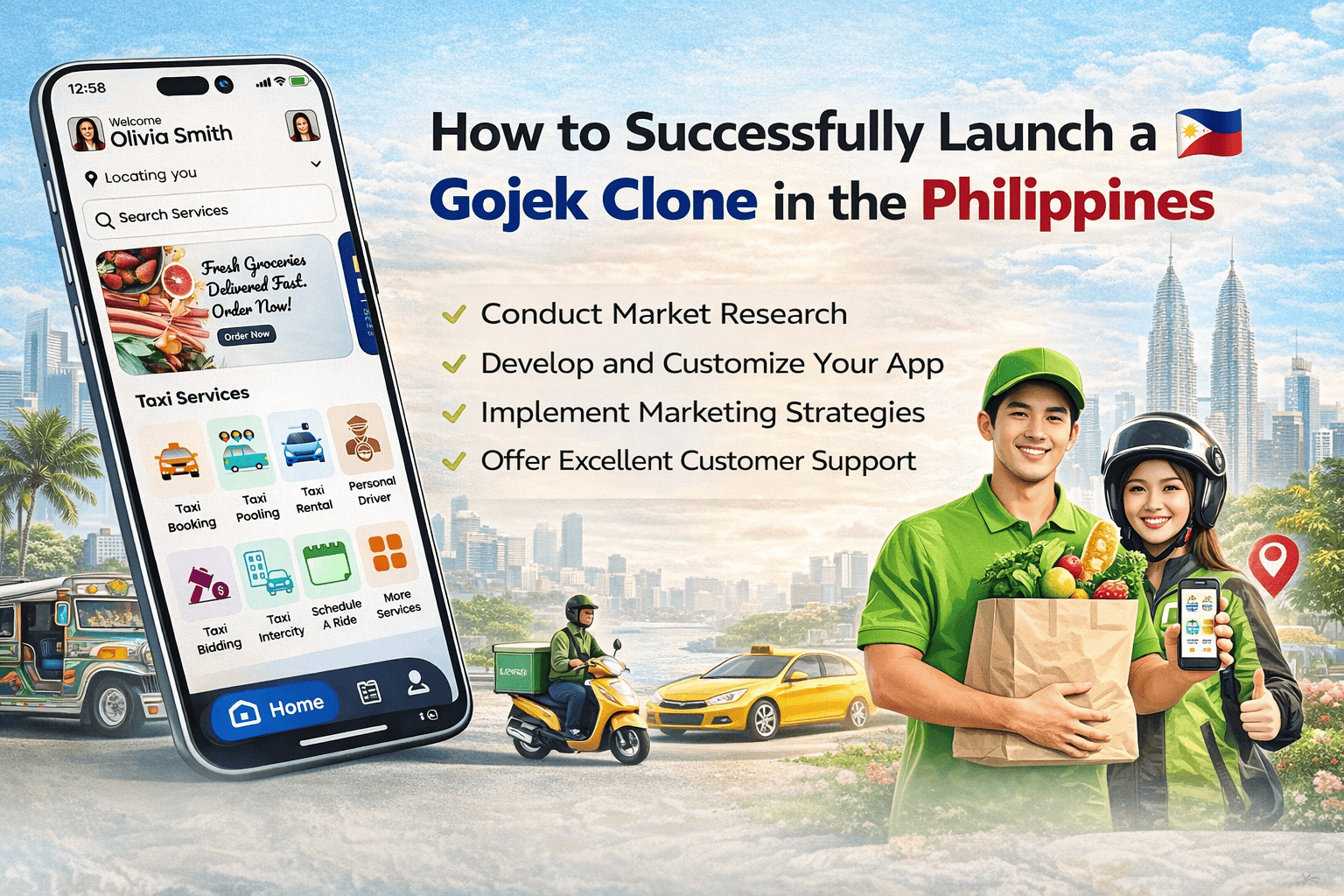
The Filipino On-Demand Market
The Philippines is known for its rooted culture and work ethics that have redefined life as a whole. Today, the work and life balance in Filipino minds feels like a progressive state where you enjoy life just as hard as you work. This affects the on-demand economy the most.
People are ready to pay for convenience. The tourism industry is growing, the corporate workplaces are growing, manufacturing and agriculture sectors are saturated and people are moving towards tech landscape. As a result, Gojek Clone in Philippines is quite a great concept.
However, competition is tough, you are in rivalry with the Gojek, Grab, and more such apps trying to be loyal to their users. But here’s the catch, the demand is growing and the market is expanding. So, you get to make a very big chance if you understand the market just right.
In this blog, you’ll get the exact framework of launch, a list of feature sets, and a complete understanding of the market dynamics.
What is the Market Dynamic for Gojek Clone in Philippines?
The Gojek Clone Market is a strategic opportunity for Filipino market. The largest players include Grab clone & Gojek clone, who define in just a few products, overlapping on ride-hailing, delivery, and payments.
This is not the only thing which drives the market. The main factors are not competition but the user’s retention, behavior, and their preferences. These are the three high indicators:
- High Smartphone penetration
- Clear preferences
- Shift in user Behavior
These three things drive the on demand economy today, so, for the market, which can seem volatile in short term, if you see in a bigger picture in a long-term growth and profitable business opportunity. Compare this with SIP, an SIP is always profitable in the long term.
However, the returns can also come early if you follow a very strategic framework.
The Essential Features in a Gojek Clone for Philippines
The Filipino users don’t look at the price first, but they do have a budget, for an average family it can be around P2 Million and it tells us that people are ready to pay for convenience. That’s why your focus with the features must be about convenience.
User side (customers)
- Clear home screen including delivery, ride food, groceries, and morejust one tap to begin.
- Quick search and suggestions for nearby locations. Display ETA and cost upfront.
- Simple booking for deliveries: pickup, drop, size (S/M/L), preferred speed.
- Payments mixed Card, wallet and cash. Display balance of your wallet and promo credit at the checkout.
- Proof of live tracking of photo and OTP for deliveries, driver’s name and number for rides.
- Chat support with templates to answer questions to common issues.
Driver side
- One app to do everything: deliveries and rides. Switch preferences: “Only rides,” “Deliver between rides, “Both.”
- Screen of earnings that shows breakdowns per job as well as daily totals. No hidden deductions.
- Quick proof of delivery and basic packaging tips included in the app.
- Rapid onboarding flow Uploading documents, a short video verification, and an initial training checklist.
Merchant panel
- Catalog management and menus and management of pickup schedules simple invoices.
- Upload bulk for merchants who frequent their site and a booking platform for regular pickups.
- Promotional slots and a campaign console for retailers who wish to be seen.
Admin and Ops
- Dispatch dashboard; manual override of disputes, hot case dashboard as well as analytics such: LTV, CAC, on-time rate.
- Promoter engine that targets neighborhood and not blasts across the globe.
Make sure you ship them properly. All else is luxury.
Business model of Gojek Clone: How Do You Earn Money?
Don’t overcomplicate. Use a couple of levers you’ve used before and ensure that the math is clear.
Primary streams:
- Commission to ride — a standard amount per journey.
- Commission for delivery typically more profitable because convenience is a priority.
- Delivery charges include distance as well as speed and size surcharges.
- Marketplace subscriptions Monthly subscriptions for sellers with high volumes (markets pharmacies, markets).
- Promotions and featured listings businesses pay to be the first in Google search.
Secondary:
- Wallet floating — low breakage and interest on prepay credit.
- Logistics contract — corporate deliveries for sellers of e-commerce.
- Advertising Local companies within the app after you’ve reached scale.
A general rule of thumb: try one merchant subscription package during the second week of your trial. If you see a few people sign-ups are made, you’ve uncovered reliable revenue early.
Operational Tips for Super Apps like Gojek
Tech is hot. Operations is the key to survival. Prioritize these:
Onboarding and retention of drivers
Rapid payouts clear commissions, transparent payments, and consistent incentives beat out weak bonuses. If drivers are able to see that they have money in the app, and are aware of how their fares are calculated the app will stay with them.
Relationships with merchants
Begin with smaller volume partners who require regular pickups. These include pharmacies, sari-sari shops which stock food items, and sellers who rely on couriers. Provide them with clear SLAs and daily performance reports. A client who has confidence in you will become an engine for growth.
Support and refunds for customers
Establish clear, simple rules for refunds as well as a 24-48-hour resolution timeframe for delivery issues. If a claim for a damaged item isn’t addressed quickly it’s easy to spread the word.
Rules for logistics
Set the size of your package and weight limits, the items you can be carrying (no fluids during hot temperatures without special packaging) and liability limits. Include this information in the application. Clear rules reduce disputes.
Localization: tiny steps that result in big
- The UI should be translated UI into Tagalog/Filipino and at a minimum, one major regional language in the event of multi-city.
- Use the familiar labelling of units and address formats. Accept “landmarks” during checkout Many Filipinos offer a landmark in place of the house number.
- Integrate the wallets that are used locally and banks. People don’t want any friction when they pay for their purchases.
- Promos for your business that are tied to local celebrations and holidays and celebrations, not just international days.
Localization isn’t just localization of only words. It’s the localization of behavior.
White-label vs custom: a practical decision
White-labeling app is the first step to start. Why? You need actual orders not a dreamy architecture diagrams. White-label can be in place in a matter of weeks. Utilize it to verify the demand and identify friction points.
Only move custom at times when:
- You can see a repeatable amount of traffic and you know which features earn money.
- Merchant integrations are needed as well as B2B contracts that white label cannot accommodate.
- You require a different dispatch algorithm which gives you a competitive edge.
Data should drive the custom work. Don’t reverse the process.
6 Week Playbook for Filipino Gojek Clone
Week 0: preparation
Choose a neighbourhood within Manila or another city that is dense. Onboard 30-50 drivers as well as 8-12 retailers across grocery stores pharmacy, local pharmacies, and food.
Week 1-2: Soft Launch
Launch the app for users with limited access. Simple promotions: delivery discount for the first 3 orders, credit for merchant referral. Check cancellations, orders and the time it takes to pick up.
Week 3-4: Optimize operations
Modify scheduling rules; enforce rules on packaging and fix the frequent UX fallsouts. Start subscriptions to merchants for 3-4 partners.
Week 5-6: Scale locally
increase marketing spending in the district in line with supply. Increase the number of merchants in the categories that influenced the volume of repeat sales.
Important metrics to monitor every day: utilization of drivers the average value of orders and on-time rates as well as the repeat rate for merchants and support tickets for 100 orders. If the utilization rate and repeat rates rise, then you’ve discovered a local market for your product.
Common mistakes that people make (and ways to avoid becoming the victim of one)
- The idea of launching a citywide campaign without density. Start with a small scale.
- The hidden fees at the checkout. Making pricing transparent.
- In the process of complication, you can overload the driver application. Make it simple Accept the app, navigate, and then send.
- Failure to validate merchant economics before the time. If merchants are losing money through your services, they’ll leave.
Find the issues, and you’ll have a healthier retention.
Final thoughts
You aren’t building an app that is a duplicate of the one you have. You’re designing a product that is compatible with Filipino rhythms, such as spending habits as well as pocket budgets holiday spikes, island-to-island logistics. The winner is the one that helps reduce the friction that occurs in daily life.
Imagine a Gojek Clone to the Philippines as a way to open a market in the neighborhood: the shop that is the fastest and cleanest as well as the most trustworthy gets customers. Your technology is your shelf but your operating principles are the products that customers buy. Start local, make pricing clear, respect merchants and drivers and you’ll discover the area where convenience is paired with profits.