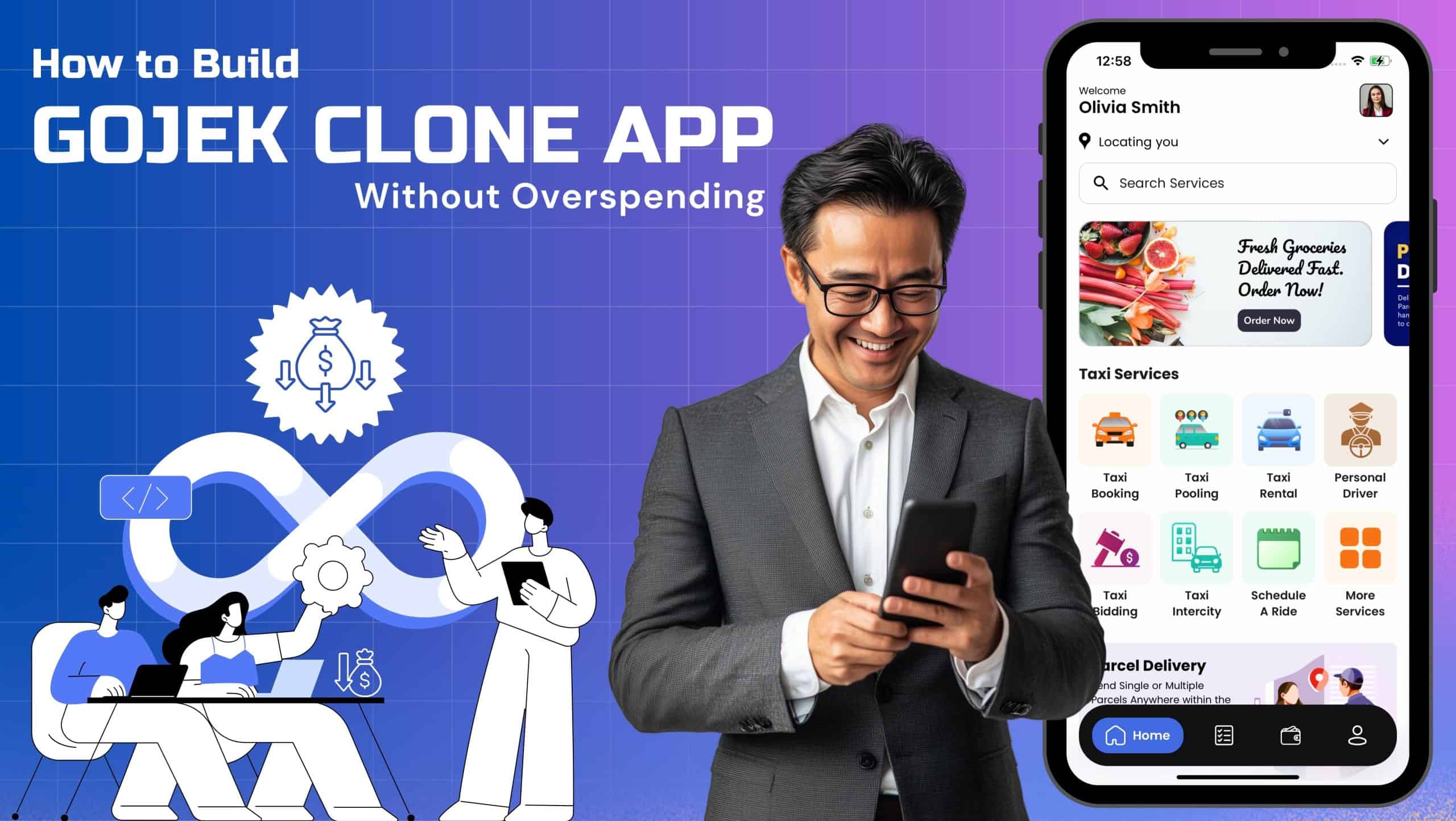
If you think of launching a Gojek Clone, it’s a smart decision. It’s the right time, right opportunity, and the perfect moment when you can begin. However, with this creative idea comes great challenges. One of them is Budget.
Budget is limited, resources are limited, now you’re stuck because you don’t know how to navigate this. Well, the frustration is real. It’s problematic. If not solved it can kill your dream to start a Multi-Service App. If you look at the market with focus, the answer is right here. If you understand the circumstance and what it means for you, you can always navigate.
Let’s understand this in detail.
What Can You Do to Start at Budget?
In simple terms, you can to understand what you need right now at priority, and what can you bet on later as the platform grows. Decide what’s important for you. You get to choose and launch with ease.
One of the very interesting ways is to launch with a White-Label Gojek Clone.
A White-Label Gojek Clone has everything you want, at a crucial costing, and you also get white-label benefits. If defined, A White-Label Gojek Clone is a ready-made Solution, which you can purchase and launch in just 2 weeks.
Let’s understand everything with precision.
Gojek Clone: Budget Friendly White-Labelling
A White-Label Gojek Clone is different. It does not serve you an MVP at cheap costs, rather, it’s an advanced solution with 14 components that compile 101+ services. Think of starting a Multi-Service App like opening a mall, not a single shop: lots of stores, lots of wiring, and a mountain of small decisions. Buying a white-label Gojek Clone is like leasing a fully fitted mall space, instead of building every shop, floor and stair from scratch. It saves time, cuts unexpected costs, and removes a lot of guesswork.
Why Gojek Clone is Cost-Effective?
- Speed to market, not months but only 2 weeks, so revenue can start flowing earlier.
- Proven, tested modules, which means fewer surprises, fewer bugs, and less money spent on firefighting.
- Ready integrations, like payments, maps, and SMS, avoid expensive specialist builds.
- No hiring overhead, no need to assemble a full team of designers, backend, mobile, QA, and DevOps at day one.
- Low Costs over Custom Development, because white-label vendors offer packages and upgrade paths, making budgeting simpler.
For founders with a limited budget, that combination is powerful, like borrowing a well-tuned engine for your Gojek Clone that you can brand and launch.
What You Get in White-Label Gojek Clone
An advanced Gojek Clone is not just a Multi-Service App with a different logo, it’s a suite of services stitched together to behave like a single, smooth product. These are the features that add real value, explained in simple language:
Native Tech
Its built in Native which lets you have the speed that you want to achieve without any compromise. On top of it, you also get Unlimited User Potential.
User App that Satisfies Demand
Robust user app, with real-time tracking, easy booking, multiple vehicle types, scheduling, and in-app chat for support.
Driver App that Simplifies Delivery
Driver app with smart routing, earnings dashboard, heat maps for demand, and quick onboarding tools, so drivers stay productive and happy.
Store App with Smart Management
Store App that restaurants and stores that handles menus, orders, inventory basics, and payouts.
Admin Panel that Makes Decision
Powerful admin dashboard, with role-based access, live operations view, cancellations and dispute tools, and one-click promotions.
In-App Wallet & Secure Payment Gateways
Built-in wallet and payments, supporting multiple gateways, cashless options, and promo engine for discounts and loyalty points.
Localization Support
Multi-language and Currency support, so the app can be launched in more than one region without a full rebuild.
Manual Dispatch Panel
It helps you to operate call centres and book rides, deliveries and other services, this lets people with no tech knowledge to buy from your app.
Earning Reports
Analytics and reporting, simple dashboards that show revenue, active users, top services and problem spots, so decisions are based on facts, not guesswork.
Identity Verification
Security and KYC flows, with OTP verification, document upload, and basic fraud controls, which keeps regulators and users comfortable.
API integrations
Extensible APIs, allowing future integrations with third-party services like fleet telematics, or local payment systems.
Each of these features removes a future expense: fewer external tools to buy, fewer contractors to hire, and fewer surprise redevelopment bills.
Source Code Ownership: What it is, and Why It Matters?
Buying a white-label Gojek Clone usually comes in two flavours: a hosted SaaS style, or full source code ownership. For budget-limited founders with long-term plans, owning the source code is often the smarter financial move, but with responsibilities attached.
Benefits of owning the source code:
- Full control, ability to customize features, add local payment gateways, or change UI to better fit the market.
- No developer lock-in, which means the app can be moved, forked, or sold as the business grows.
- Long term cost savings, because running own updates and customizations can be cheaper than ongoing SaaS fees at scale.
- Intellectual Property clarity, which helps in investment conversations or if selling the The business deal will be done later.
Things that should be considered:
- Accept clean documentation, Git access, and a handover plan: commit history, developer environment setup, deployment scripts, and API docs.
- Clarify licensing: is the code exclusive, or does the vendor sell the same package to others with slight branding changes?
In case the budget is tight, but the plan is to scale and customize later, then buying source code now would be like buying a plot of land in the future expanding neighborhood, owning it early would be better.
Conclusion & Next Steps
The idea of launching a Multi-Service App with a limited budget is feasible at every point of the process if the right approach is taken: service that drives the most revenue should be among the first; white-label Gojek Clone cuts time and cost; buying source code is dependent on long-term plans.
Refer to the following quick checklist to take next steps, treat it as a launch roadmap:
- Decide on the core services with which to start, and focus on offering 2 to 4 services that are in the highest demand.
- Get a demo of the Gojek Clone to evaluate UX and flows, look at rider, driver, merchant, and admin panels.
- Clarify ownership: hosted solution versus full source code purchase, get license terms in writing.
- Prepare local integrations: payment gateway, local regulations, KYC needs, and language settings.
- Plan a lean marketing launch: target city, fleet onboarding, pilot offers, and a small support team.
- Measure, learn, then expand services and geographies: grow like planting branches, not uprooting the tree.
In case you are one of those who can’t wait to get the product working, apply for demo applications and a technical guide, observe genuine screens and flows, and lay out the packages around. Start smart, save money, and let the platform do the heavy lifting so the company can concentrate on clients and growth.