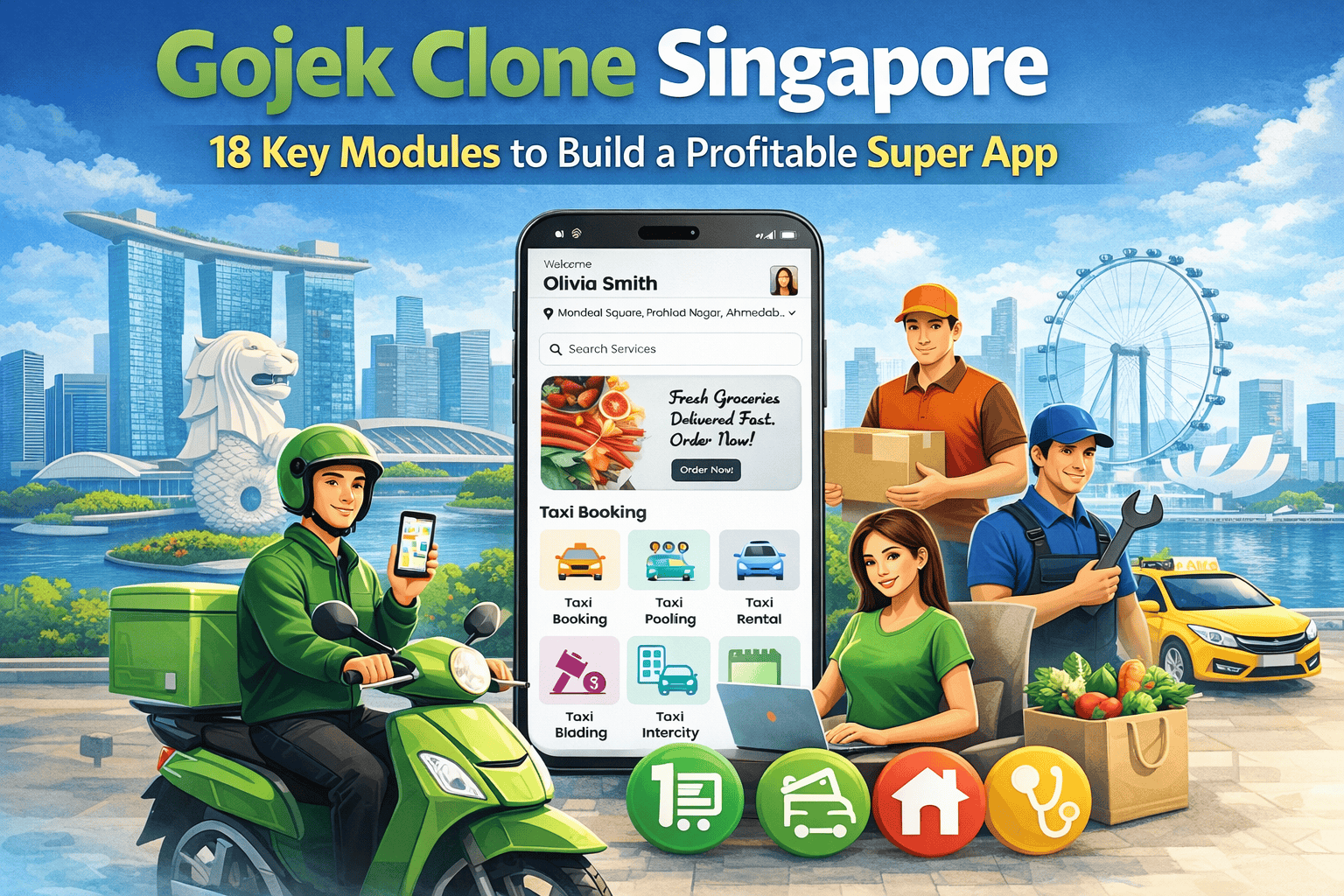
Singapore is a dense, tech-ready city where people value speed, convenience, and clear prices. As of mid-2025 the population sits at just over 6.1 million, including many non-resident workers — a compact market but one with high spending power and heavy app use.
Smartphones and mobile connections are widespread: there are far more mobile connections than people, and most residents expect services on their phones. That makes a multi-service app model ideal for fast adoption.
Globally, ride-hailing and on-demand services keep growing, and Singapore’s shared mobility and delivery markets are expanding too. A well-built multi-service app that solves local needs can capture users across many small but lucrative verticals.
Quick Market Snapshot of Singaporean Economy
| Metric | Why it matters |
| Population ≈ 6.1M (2025) | Compact market — easier to reach critical mass in cities. |
| Mobile connections >160% of population | People are on phones. Good for app adoption and frequent use. |
| Shared mobility revenue (SG) | Ride-hailing is a leading segment; demand is steady. |
| Online food delivery ~USD 622M (2023) | Delivery is proven and still growing — add wallet and subscription models. |
How 18 Components Compile in One Gojek Clone App?
A single service can bring users in, but users who stay are those who find repeated value. Multi-service apps turn occasional users into daily users by giving many small reasons to open the app — ordering lunch, booking a pet sitter, or calling a roadside rescue. Each component can be monetized and cross-sold, multiplying revenue without multiplying customer acquisition cost.
The 18 Service Components
| No. | Component | Short description | Main revenue route |
| 1 | Taxi Booking | On-demand city rides | Commission + dynamic pricing |
| 2 | Parcel Delivery | Quick city parcels | Per-km fee + surge |
| 3 | Store Delivery | Grocery & retail delivery | Delivery fee + placement fees |
| 4 | On-Demand (tasks) | Handyman, cleaning, small jobs | Commission + service fees |
| 5 | Pet Care | Walkers, grooming, vet pickup | Commission + subscription plans |
| 6 | Car Care | Wash, valet, maintenance pickup | Fixed service fees |
| 7 | Roadside Rescue | Towing, flat tyre help | Premium fees + subscriptions |
| 8 | Beauty & Wellness | Home salon, massages | Commission + booking fees |
| 9 | Video Consultation | Doctors, therapists online | Pay-per-consult + subscription |
| 10 | Healthcare | Lab pick-up, medicine delivery | Delivery/commission |
| 11 | Carpooling | Shared rides, commutes | Lower fee + subscription passes |
| 12 | Delivery Genie & Runner | Hyper-local errands | On-demand fees |
| 13 | Bid for services | Live bidding for jobs | Platform fee on successful bids |
| 14 | Buy/Sell/Rent Cars | Classifieds + rentals | Listing fees + transaction cut |
| 15 | Buy/Sell/Rent Real Estate | Short-term and long-term listings | Listing + lead fees |
| 16 | Buy/Sell/Rent General items | Local marketplace | Listing fees + ads |
| 17 | Nearby Businesses | Local discovery + deals | Sponsored listings |
| 18 | Track Family & Employees | Location & safety features | Premium subscription |
Grouping components for launch and speed
You do not need to launch all 18 at once. Group them into three waves:
Wave 1 — Core volume drivers (launch month 0):
- Taxi Booking, Parcel Delivery, Store Delivery, On-Demand tasks, Delivery Genie
These create frequent app opens and form the backbone of supply-demand networks.
Wave 2 — Trust & retention (months 2–6):
- Beauty & Wellness, Pet Care, Car Care, Roadside Rescue, Carpooling
They increase monthly active users and introduce subscriptions and repeat spend.
Wave 3 — Marketplace & value stack (months 6–12):
- Buy/Sell/Rent cars, real estate, general items, Nearby Businesses, Track Family & Employees, Video Consultation, Healthcare, Bid for services
these transform the app into a sticky ecosystem and improve lifetime value.
How each component makes money?
- Commissions on transactions (rides, bookings, deliveries).
- Delivery & convenience fees for on-demand and runner services.
- Subscriptions for premium tracking, insurance, or frequent-user passes.
- Listing & advertising fees in marketplaces and business discovery.
The mix matters: rides and deliveries give immediate cash, while subscriptions and listings give steady, predictable income.
Prcatical Tips For Launching Gojek Clone in Singapore
Localization: It is recommended that you use English and local languages (Malay, Mandarin and Tamil) to communicate with all parties involved in your new business.
Partnership: In order to build a distribution network for your products, it is essential that you partner with local businesses such as hawker centres and supermarkets as well as mail-order pet supply companies.
Marketing: An important part of starting your business will be to implement marketing strategies to provide coupons to new riders so that they can use the coupon as a way of receiving credit for their first ride. You may also wish to consider offering trial subscriptions to your new rider’s family.
Simple On Boarding Process: Drivers will need to be able to join your company through a straightforward registration process that will have set pay days and will provide them with several different types of work schedules.
Legal Compliance: Your new business will not be able to begin operating until you have obtained the necessary permits and insurance policies from regulatory agencies within the Singapore Government.
Technical checklist for a smooth white-label launch
- Clean driver & merchant apps + modular admin dashboard.
- Modular architecture so you can turn components on/off.
- Payment gateway with local support and e-wallet integration.
- Lightweight UI for quick loading on lower-end phones.
- Analytics for LTV, CAC, frequency, and retention by vertical.
Metrics to watch (KPI table)
| KPI | Why it matters |
| Monthly active users | Growth and adoption |
| Trips/deliveries per user per month | Engagement depth |
| Take rate (platform cut) | Revenue efficiency |
| Churn & retention | Product-market fit |
| Supply fill rate (driver/merchant availability) | Service reliability |
Wrapping it up,
To be successful in developing an effective Gojek Clone App in Singapore, you must create it with three primary elements: convenience, reliability, and working with local businesses.
First, identify the main five to six components that will create repeat customers and earn consistent revenue, then you can increase customer lifetime value by adding additional services that complement the initial components you selected. Given Singapore’s high level of mobile device penetration and that the shared mobility and delivery service markets are rapidly growing, it would be very logical to pursue developing a multi-service app here.
However, the final outcome will be determined by your execution of the app’s will, localisation, and attention to relevant legal and regulatory requirements, because your app could either be something a customer uses multiple times on a daily basis or a mere bookmark on their home screen.